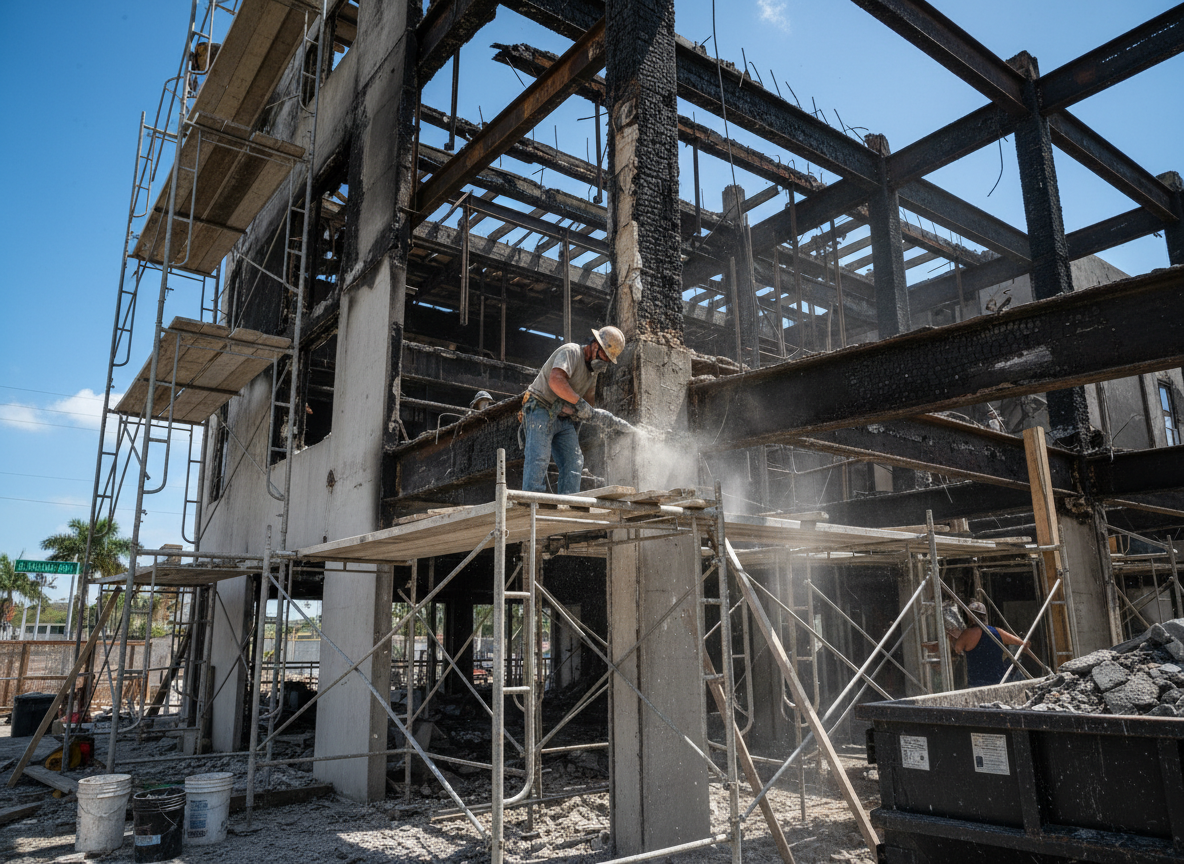
In Hallandale Beach, many homes in Golden Isles and Three Islands date from the 1960s and 1970s with wood-frame construction on slab foundations. After a fire, charred joists and wall studs often retain hidden moisture from suppression water, and the area’s tropical monsoon climate with wet summers accelerates mold growth if drying is incomplete. Technicians must remove compromised members, treat remaining surfaces with antimicrobial agents rated for high-humidity exposure, and install new framing that meets current Broward County wind-load requirements before drywall and finishes are replaced.
Fires in Hallandale Beach Boulevard District properties frequently involve older electrical systems that arc behind walls, leaving soot trails that travel through HVAC ducts. Restoration crews isolate affected duct runs, replace insulation, and pressure-test new sections to prevent smoke odor re-entry once the system restarts. Because nearby Hollywood and Aventura share the same coastal humidity, crews schedule dehumidification equipment sized for rapid moisture removal during summer storms to keep timelines on track.
Structural repairs here also account for soil conditions near the Intracoastal Waterway in Sunny Isles Beach spillover areas, where high water tables can complicate foundation work. Crews excavate only as needed, install temporary shoring rated for local wind exposure, and coordinate inspections with Broward County building officials before backfill. Homeowners should expect visible inspection ports left in place for several weeks so any residual moisture migration can be monitored before final enclosure.
Technician insight
In Hallandale the thing that catches most people out with Structural repair after fire is how quickly wet-summer humidity drives moisture into the slab edges and subfloor after suppression water sits for even 48 hours; older Golden Isles homes with terrazzo over slab hide this until the new flooring starts cupping weeks later.
Three Islands townhouse fire
Suppression water reached the crawl space beneath a 1970s townhouse near Three Islands Park. We found saturated rim joists and active mold on the subfloor. After selective removal and targeted drying we sistered new joists, sealed the slab edge, and restored the flooring so the owner could move back in before the next wet season.
How it works
- 1
Initial Assessment
Technicians inspect load paths, document char depth, and test moisture levels in framing and slab edges.
- 2
Selective Demolition
Remove unsound wood and drywall while protecting adjacent areas from further soot spread.
- 3
Structural Replacement
Install new joists, headers, and sheathing matched to original spans and upgraded to current codes.
- 4
Drying And Treatment
Deploy commercial dehumidifiers and apply sealers suited to Hallandale’s humidity before finishes are restored.
- 5
Final Inspection
Coordinate with county inspectors and verify odor-free conditions throughout the repaired sections.
Pricing
Upfront quotes issued after inspection; final cost depends on extent of hidden damage and required engineering.